Partscaster Build Part I - The Plan
- music tech
I love making guitars. There was a point growing up where I wanted to be a luthier. Electronics were always pretty accessible, but any sort of woodworking was really intimidating. But now with the makerspace my confidence is growing with those skills.
This project isn’t quite building a guitar from scratch, but it’s a step closer than projects I’ve done in the past. I’m assembling a “partscaster” of leftover guitar parts I’ve collected over the years.
Starcaster
My first ever guitar was a budget Strat, a “Starcaster by Fender”. This was my guitar from a picture I uploaded to Wikipedia before completely ruining the instrument.
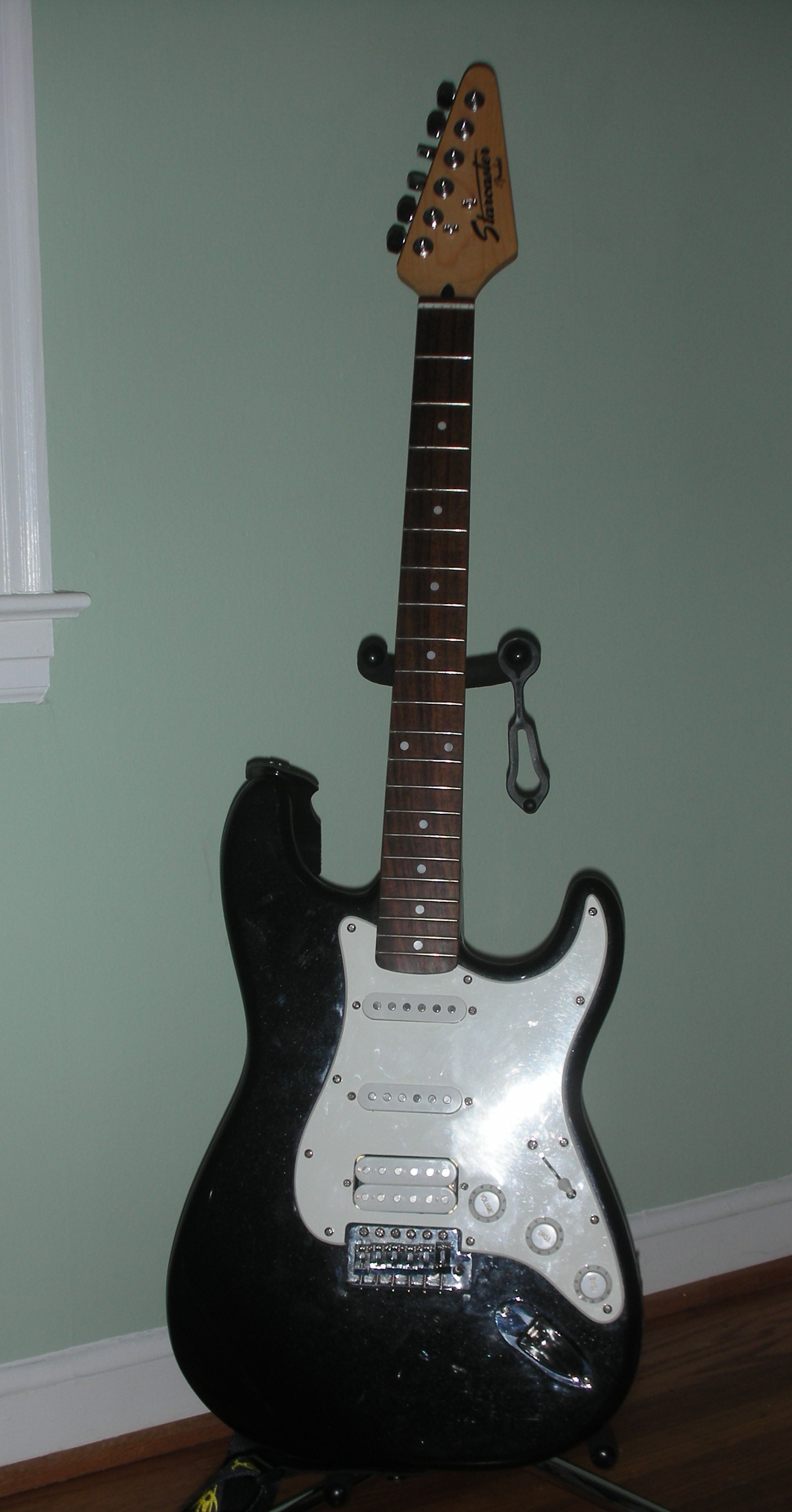
I proceeded to destroy the guitar, unleashing my destructive teenage angst on it in an attempt to make it “punk rock.”
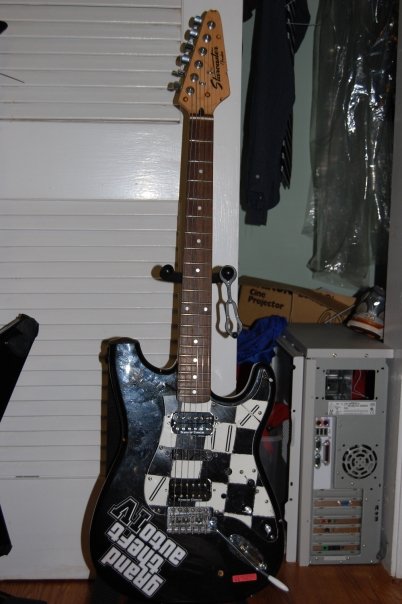
I cut parts out of it, scratched and burned the finish, drilled holes in it, hammered huge nails into it, etc. While I think it’s overwhelmingly in poor taste, I will say the checkerboard pickguard was a cool idea, one I may come back to eventually.
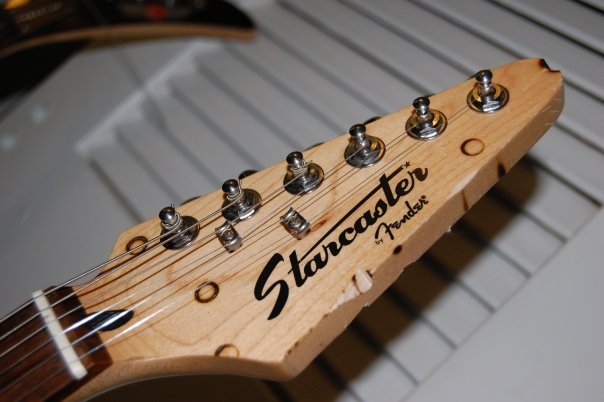
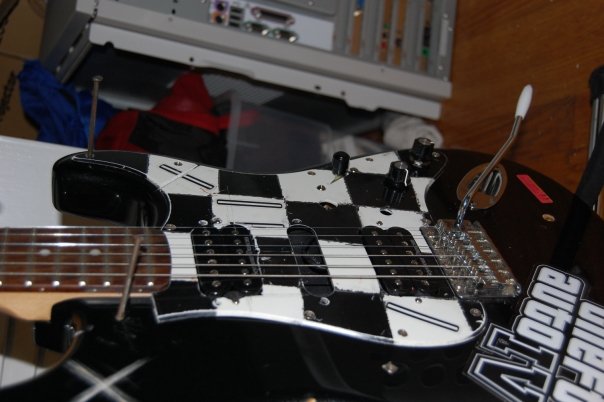
(Forgive the low resolution of these photos, they are from 2011).
Eventually the guitar was unplayable. The pickups got moved to another guitar, the hardware got stripped for parts, and the shell of the thing sat in my closet for 15 years.
Revival
In April I started getting the guitar bug again. I thought about the P-Rails that were just sitting in a box. I thought about how the laser cutter allows me to make custom pickguards. And I thought about my old Strat.
The body is completely unusable; the finish is shot and the body is cracked where the tremolo bridge attaches. The headstock is in pretty bad shape too, but the neck itself is still salvageable. It feels surprisingly nice to play, and only has minor damage.
With some wood restoration the general shape of the headstock can be restored, but we’ll need a donor body.
I ordered a Squier Mini Affinity Jazzmaster HH refurbished for very cheap. The neck on it is absolute trash; the fingerboard looks like plywood and is full of nasty marks and discoloration. The thing can’t hold tuning at all. But I got it for the body and that part seems solid. It is a lovely mint green color, a double-humbucker setup, and has a hardtail bridge which makes it easy to work with. The body is very light; smaller than a normal Jazzmaster but comparable to a normal Strat.
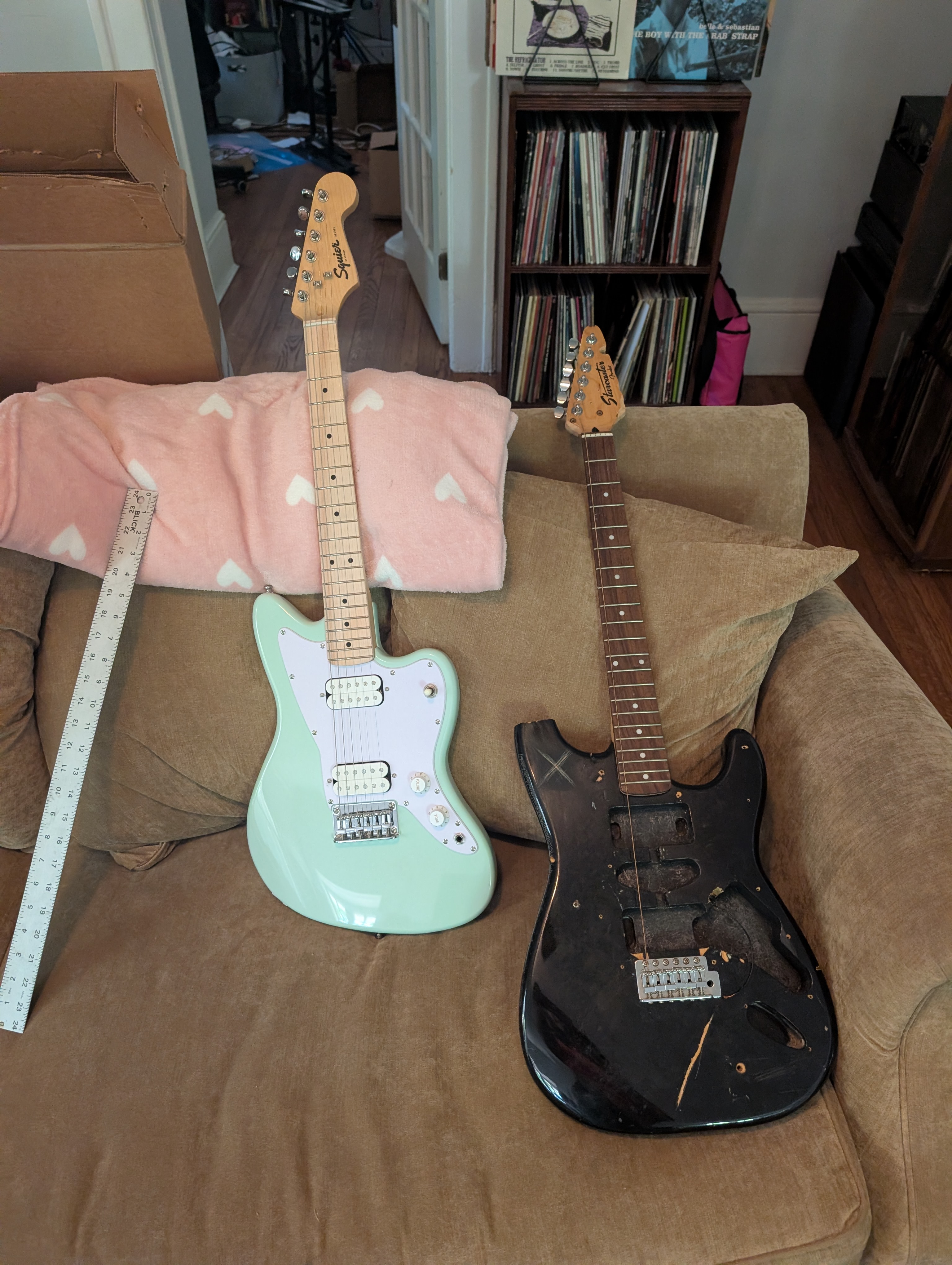
The two guitars have different scale lengths. The Strat is a normal Fender 25.5” scale length, while the Squier is a mini scale, clocking in at 22.75”. However they are surprisingly compatible. The Squier has the same neck width at the nut and last fret, and uses normal-sized hardware. This means the neck pocket is the same size also. The way they reduce the scale length is dropping a fret or two off the neck and moving the bridge forward about 8mm. For the bridge I can either move it back, or build a custom bridge plate that uses the same mounting holes but sets the back wall back the appropriate amount.
I used Inkscape to plan out a pickguard design, using some Jaguar/Jazzmaster dimensions I found online. Obviously this is incomplete but you can see the vision I think.
The plan
- Restore the Starcaster headstock, preserving the decal if possible
- Replace the tuners with Fender brand ones (leftover from when I upgraded the Tele to locking tuners)
- Attach the neck to the Squier body
- Replace the stock humbuckers with P-Rails
- Add 3x 3-way slide switches in place of the toggle switch, allowing all pickup combinations
- Move, adjust, or make a new bridge to compensate for the scale length
- cut a new pickguard with a custom decal
- Upgrade any assorted hardware I have left over (strap locks, etc)
Stay tuned for progress updates!