JTM45 Build Part II
- music tech
- electronics
A few weeks ago I wrote about the Marshall JTM45 amp I put together. In it, I teased a bigger mod I wanted to do.
Comparing the schematics between the JTM45 (actually the Fender Bassman but the circuits are basically identical) and another classic British amp, the Vox AC30/6, I found the topologies to be incredibly similar. The Marshall sounds great for sure, but I’d rather sound (in the words of a friend) “more Brian May, less Jimmy Page.” So I converted my amp to a hybrid of the two.
Below are both schematics with the common sections highlighted. We can step through them one by one.
Comparison


Power (red)
The power systems are very comparable between the two, as expected for an AC/DC converter. The most notable difference is the lower output voltage of the AC30, a 30 watt clean amp, compared to the 45 watt high-gain JTM45. The JTM45’s power transformer lines are 325VAC on each side, compared to 180VAC. The schematic shown here for the AC30 has a solid-state rectifier, but earlier versions used a tube rectifier also.
Both use a choke on the B+ lines. The power capacitors have different values to account for the different voltages and noise profiles. The JTM45 has a solid-state half-rectified B- line that the AC30 doesn’t. The JTM45 progressively steps down the B+ lines from the later stages to the earlier stages, while the AC30 uses a common B+ line. But at the end of the day, DC volts are DC volts, the specific topology of the power supply matter little beyond the output voltages (as long as they are properly filtered).
Trem (green)
The AC30 has a tremolo circuit, highlighted in green. This adds 3 additional tubes which I don’t have the space for, and honestly the circuit makes my head spin a little bit1. I’ve got a decent tremolo pedal so we can ignore this (treat the output as ground).
Input buffer (teal)
These two sections are almost exactly identical. Bright and normal channels, each with a low and high input with a 68k divider. Both are 12AX7s (at least on the JTM45; the Bassman used a 12AY7) buffering each channel. The only difference is the tube biases: the B+ line is lower on the AC30 (probably about 238V compared to 432V) and the cathode and plate components are different. This will be a recurring theme throughout this analysis.
Stage 2 preamp (blue)
Here there’s a big difference in design but a small difference in practice. The Bassman/JTM45 mixes down the two channels here (in brown), causing both channels to go through the tone stack. The AC30 sends only the bright channel through this stage, sending the normal channel directly into the phase inverter stage (note the summing resistors in brown are in the orange section instead). Frankly I prefer the flexibility of getting tone controls on both channels, so we’ll stick with the JTM45’s approach here.
Notice the bright cap is the same in both circuits2 (100p). Now the value of the volume pot is different by a factor of two (500k vs 1M), which moves the cutoff by a factor of two. But still this is much more similar than I would have expected between circuits known for sounding so different. Again the B+ and cathode resistors are different changing the biases slightly. The AC30 has a higher cathode resistor but that’s likely to compensate for its lower B+, the gains are probably similar. The cathode resistor is actually smaller on the current buffer, probably to compensate for the higher loss of the AC30’s tone stack.
Tone stack (yellow)
This is another major difference between the two circuits, and probably has the largest contribution to the tone differences between the amps. The JTM45 uses the Marshall tone stack, with Bass/Mid/Treble controls, while the AC30 has just Bass and Treble. You can use the ubiquitous Duncan Tone Stack (for which there’s an online version now) to see the differences between the two curves (Marshall is blue, Vox is red).

You can interactively compare the two here. The Vox has a lower overall output and much more of a mid scoop.
Phase inverter (orange)
The phase inverter uses the same differential amplifier approach in both circuits. Apart from the summing differences discussed earlier, there are a few other differences. The Bassman/JTM45 has a presence filter on the opposite side of the amp, optionally bleeding off the highest frequencies. It also has a negative feedback line from the output (salmon). It has a 47pF capacitor across the outputs for stability, and an asymmetrical plate resistor design, with the input side at 82k and the reference side at 100k. The AC30 has symmetrical 100k plate resistors, higher input coupling capacitors (47nF vs 22nF), and different biasing. The output coupling caps are comparable (100nF vs 150nF).
Power amp (magenta)
This is another section that’s pretty different in theory, but not that different in practice. The AC30 uses two stages of lower-gain EL84 tubes, while the JTM45 uses one stage of EL34s. In addition to the gain differences, these tubes have different pinouts, so switching them is not trivial. At the end of the day, most of the tonal character has come from the phase inverter and the pre-amps; the power amp serves to make that signal loud, so using the louder JTM45 design makes sense. The AC30 sends the 220k grid leak resistors to ground, while the JTM45 connects them to its -50V B- line. This is just a more complicated example of the differences in tube biases.
The AC30 also has an additional “tone cut” filter: a 250k ohm pot and 4.7n cap acting as a high-pass filter shorting the high frequencies across the differential amplifier. This filter sweeps from above 30kHz down to 130Hz. The AC30 has a 1.5k gate resistor, while the JTM45 has a 5.1k gate resistor (not in the schematic).
Changes
A complete conversion to an AC30 would be an enormous undertaking, but a hybrid of the two is quite doable. I did this in stages, with the most impactful changes first. In order to speed up the iteration cycle and not wear out the tube holders by constantly removing the tubes between every change, I rigged up a little mount with some leftover plywood to hold the amp while I work.

Tone stack
Even though the two tone stacks are pretty distinct, the changes required are minimal. Both use 22nF caps for C2 and C3. Both are input through a capacitor into the top of the treble knob and output on the center of it. The bass pot is 1M in both cases, though the treble pot changes from 250K to 1M. I had a 1M left over from the master volume mod for this. I changed the 250pF cap to a 50pF, the 56k resistor to a 100k, swapped the treble pot, removed the mid pot and moved the bass pot into it’s spot, added a 10k resistor across the bass pot, and sent the bottom to ground, and sent the 22nF cap that had been going to the mid pot to the center of the bass pot.

Tone cut
Using the 250k pot that used to be the treble pot, I added the tone cut filter across the differential amp. Because I’d already done the master volume mod, I tied these into the master volume pot, but if you haven’t done this you can place these where the grid leak resistors jump to the the power tube gates.
I didn’t like the way the 4.7nF capacitor sounded, so I ended up using a 47nF capacitor instead, making the extreme end of the low-pass filter cutoff at around 13Hz instead of 130Hz.
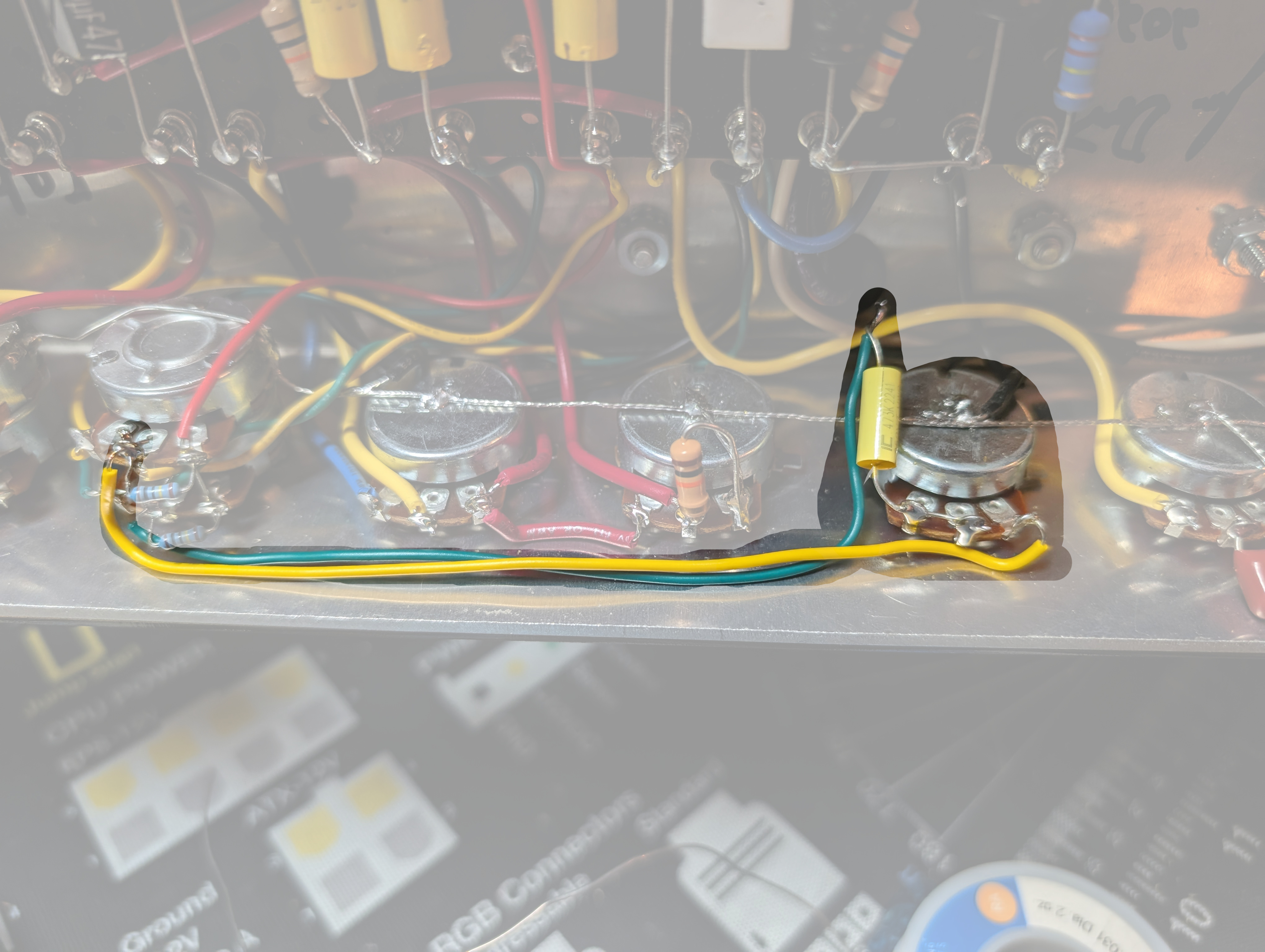
The difference between the 100pF and 150pF coupling capacitors would normally be somewhat negligible, but because adding this pot effectively halves the output impedance, increasing the capacitance compensates here by keeping the cutoff in a similar spot, maintaining the low-frequency response. I added 47nF capacitors in parallel to bring these up to 147nF.

The JTM45 presence knob provides a similar control as the tone cut with a different approach, but since there’s already a hole cut for the pot and it’s already working, it doesn’t hurt to keep both.
Re-biasing
So far these changes have been pretty easy to accomplish and had large effects on tone. Adding a tremolo and switching EL34s to EL84s are extremely difficult tasks and would require more tubes which we don’t have space for. Outside of that, the only difference is the tube biasing.
Originally I’d planned to re-bias all the tubes to match the AC30 versions. I bought all the components to change the cathode and plate resistors to match. However, the significant difference in B+ voltages adds a significant complexity to this operation. The transformer outputs a much higher baseline DC voltage with the JTM45 and I definitely don’t want to replace it. Simply adding a voltage divider to drop the voltage by a factor of almost two would be quite inefficient and makes me nervous.
I’d rather keep the B+ lines the same and adjust the biases so that the gain of each stage is the same as the AC30, even if the components are different. However, it’s difficult to calculate the gain at each stage. I couldn’t find an AC30 schematic that had test point voltages indicated. If I had one, I could measure them but I don’t. I tried simulating them in a circuit simulator but the load, including the coupling cap values (which seems unintuitive to me), seems to play a significant role in the resulting gain, making it hard to compare.
For example, I simulated the first stage pre-amp gain of the JTM45 and found it to be about 50. But the AC30 I found anywhere from 35 to 60, depending on the B+ voltage and the size of the coupling cap and volume knob.
I tried measuring them on the oscilloscope, but the tube rectifier would flicker and scream at me if I connected the scope across the differential amplifier. And if I don’t have an AC30 to compare it to it doesn’t do much good regardless.
I tried replacing the B- with ground, hypothetically reducing the gain of the power amp stage. However this also made the tube rectifier angry, suggesting I probably need to adjust some other biases to compensate. I didn’t try removing the negative feedback as that would make the already over-gained amp even louder and dirtier.
In the end, I decided to keep the tube biases where they are. I’ve got a louder amp than a true AC30, and at low gain it sounds quite pleasing, on the edge of breakdown depending on how hard I play. The master volume means I can tune the gain and therefore the cleanliness independent of volume, so there’s no harm in keeping the gain low. And there’s quite a lot of bite there if I want it.
If I were to re-bias anything, the phase inverter would be the most important, followed by the preamps, since these are were the most clipping is likely to occur. In hindsight, I might want to try biasing the phase inverter evenly, since the 82k/100k imbalance could be the source for asymmetric clipping.
Solid-state rectifier
I also attempted the solid state rectifier mod I discussed previously. But adding a diode bridge in parallel with the tube rectifier made it very unhappy (despite the tube rectifier being disconnected from the output). I think I have to disconnect the transformer center tap when using the diode bridge, but exactly which lines need to be disconnected and which can stay connected is unclear, and I don’t want to have a 5-pole switch as that would be incredibly expensive. I don’t have a big enough switch for these voltages right now anyway, so I decided to come back to this if/when the tube rectifier blows.
Conclusion
At some point I want this to be an amp rather than a project, so I decided to take it home in this state for now. I did a side-by-side comparison with my clean amp. It sounds lovely in this state; with the gain low it has a comparable brightness but a deeper low and mid range, and a bit more saturation when playing hard. The low strings almost sound compressed. Cranking the gain and the treble gives it this great energy that reminds me of Marc Bolan. I think I’m going to use both on the Punter album I’m working on, though I’m not sure yet if I want to use them in parallel or for different guitar parts.
I have kinda caught the amp building bug though. Might do a Princeton Reverb build for a friend one day; she’s wanted one ever since we played one at Big House Guitars and I think doing a build with a spring reverb would be soooo cool.
-
I happened to look at the schematic for a Princeton Reverb last night and that tremolo is much more straightforward: one triode as an oscillator (feeding back on itself) oscillates the power stage grid bias between a slightly negative B- and a highly positive B+.
There are a few things I can identify in the AC30 schematic though. On the output of the sub-circuit there’s three 1M ohm resistors and four 4.7nF capacitors. These are acting as an extremely sharp (4th order) high-pass filter with a cutoff around 30Hz. This likely is to filter out the DC offset while keeping the audio signal and as much of the low-frequency content of the tremolo (probably around 5-20Hz) as possible. Also interesting is that rather than summing the signal with the normal and bright channels, they put it on the opposite side of the differential amplifier. I suppose the thought is you aren’t going to be using both channels at the same time, so you can treat the opposite side as ground. I am curious what it would sound like to run two guitars through this amp at the same time… ↩ -
Its interesting to me that back in the day amp designers would add extra jacks and buffers to have multiple channels when the only difference between them is a single bright cap. Seems much simpler, cheaper, and user-friendly to have 1 channel with a switch that optionally connects the bright cap. That’s 2 jacks, half a tube, and a pot saved. Heck, you can switch the input resistor as well and have just one jack instead of 4 for the price of two switches. But IDK, maybe switches were more expensive, or they really expected multiple channels to be used at the same time? If someone knows the history I’m curious. ↩